
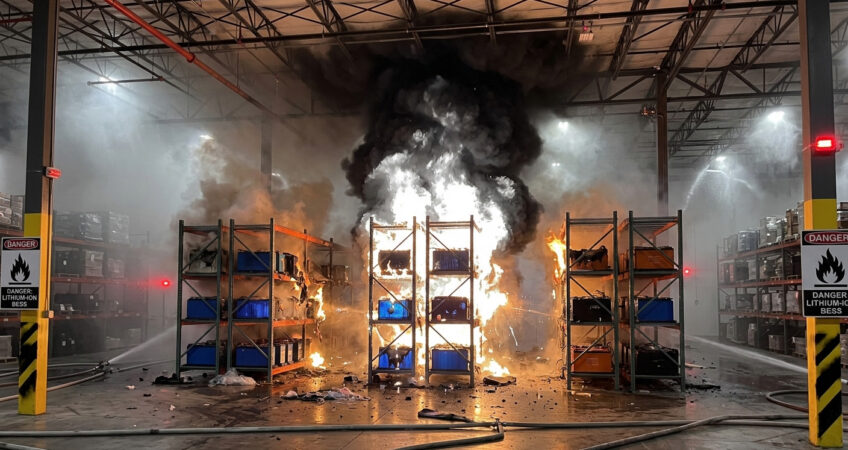
Lithium-ion and lithium-metal batteries are now embedded across modern infrastructure. From energy storage systems and EV charging networks to telecom facilities and industrial equipment, they’ve become a foundational part of how power is stored and delivered.
But they do not behave like conventional fire risks.
When these systems fail, they do not simply ignite. They can enter thermal runaway, producing flammable gases, escalating rapidly through adjacent cells, and in some cases re-igniting long after the initial event appears controlled.
That behavior fundamentally changes how protection systems need to be designed.
Why Lithium Battery Fires Are Different
At the center of the issue is thermal runaway. Once initiated, a single cell can become a self-sustaining reaction that generates heat, releases gas, and drives propagation through surrounding cells.
Common initiating events include internal cell defects, overcharging or electrical faults, mechanical damage, or manufacturing irregularities.
The failure sequence is typically a progression rather than a single event, beginning with overheating, followed by electrolyte breakdown, off-gassing, venting, ignition, and in severe cases, propagation that may lead to explosion risk depending on confinement conditions.
The critical takeaway is straightforward. By the time visible flame is present, the failure process has often already been underway for some time.
Detection Strategy: Identifying Failure Before Fire Develops
Traditional smoke detection alone is not sufficient for lithium battery environments. These systems require layered, earlier-stage detection strategies that focus on identifying precursors to ignition.
A properly integrated Battery Management System (BMS) forms the foundation of this approach. It continuously monitors temperature, voltage stability, charge and discharge behavior, and fault conditions. From a fire protection standpoint, these signals should not remain isolated within the electrical system. They should be integrated into the fire alarm and supervisory network to support coordinated response actions.
Off-gas detection provides an even earlier indication of failure. Thermal runaway often begins with the release of gases such as hydrogen, carbon monoxide, volatile organic compounds, and electrolyte vapors before smoke or flame is present. This makes gas detection one of the most valuable early warning tools in environments such as BESS installations, telecom battery rooms, EV infrastructure, and industrial storage systems.
Thermal detection methods, including infrared imaging and linear heat systems, are effective for identifying abnormal heating patterns across racks or containerized systems. Aspirating smoke detection can still play an important role in early warning applications, although it may not always precede off-gassing events.
Suppression Strategy: Cooling as the Controlling Objective
Lithium-ion fire protection is often misunderstood as a problem of extinguishment. In reality, the primary objective is temperature control and propagation prevention.
Water-based suppression remains the most effective and widely applied strategy for lithium-ion systems due to its cooling capacity. Sprinkler systems, deluge systems, and water spray configurations are commonly used to absorb heat and limit the spread of thermal runaway between adjacent cells or modules.
While water introduces considerations around runoff and cleanup, it remains the most reliable method for managing heat-driven propagation in real-world conditions.
Clean agent systems such as FK-5-1-12 (Novec 1230), HFC-227ea (FM-200), and inert gas systems serve a different role. They are effective at suppressing open flaming combustion and protecting sensitive equipment, but they do not provide meaningful cooling. As a result, they cannot reliably interrupt thermal runaway on their own and are best used as supplemental protection.
Aerosol systems may provide localized flame knockdown, but they also offer limited cooling capacity and limited control over propagation between cells.
Class D agents remain applicable only to lithium-metal fire scenarios and are not generally suited for modern lithium-ion installations.
Explosion and Gas Management
One of the more significant hazards in lithium battery environments is the potential accumulation of flammable gases during failure conditions, particularly within enclosed or poorly ventilated spaces.
Managing this risk requires a combination of mechanical ventilation, gas detection interlocks, deflagration venting, explosion relief systems, and properly designed exhaust pathways to prevent hazardous buildup.
Guidance for these systems is commonly drawn from NFPA 68, NFPA 69, and applicable building code requirements.
Passive Protection and System Design
Effective lithium battery protection begins well before suppression is considered. Passive design strategies play a critical role in limiting the severity and spread of incidents.
This includes the use of listed energy storage systems, UL 9540 and UL 9540A tested configurations, fire-rated enclosures, physical separation between modules or systems, dedicated battery rooms or outdoor installations where feasible, and adherence to separation requirements outlined in NFPA 855.
In practice, layout and physical design often determine the upper limit of system performance. Suppression systems cannot compensate for poor spatial or containment design.
Occupancy-Based Design Considerations
Protection strategies vary significantly depending on application type.
Utility-scale and BESS environments typically rely on off-gas detection, thermal monitoring, water-based suppression systems, explosion venting, and remote monitoring integration.
Commercial UPS installations often combine BMS integration with clean agent systems and sprinkler protection, supported by early smoke detection strategies.
Warehousing environments and forklift charging areas emphasize ventilation, heat detection, sprinkler protection, and separation from combustible storage.
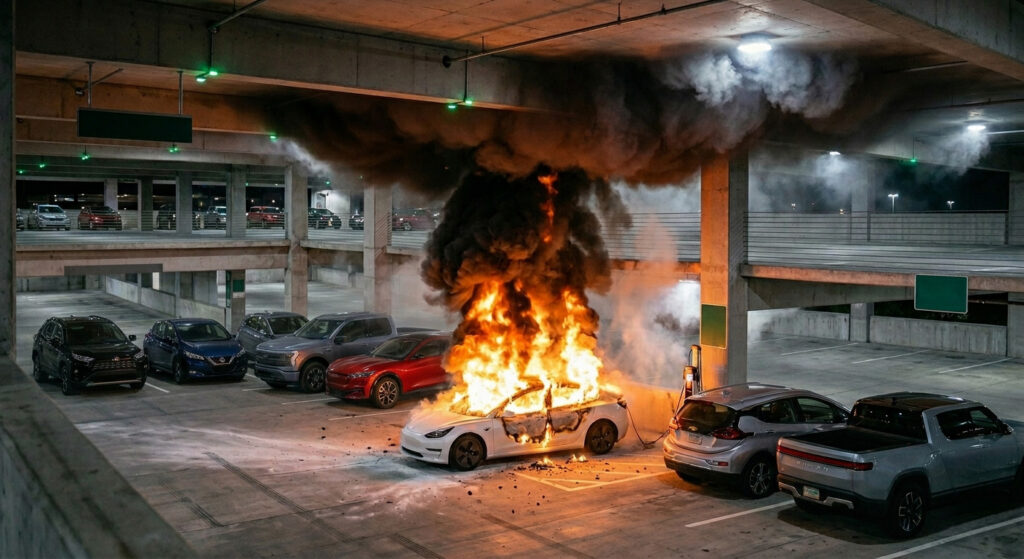
EV parking structures introduce additional challenges, requiring thermal monitoring, high-capacity water supply planning, fire department access coordination, and defined isolation procedures for involved vehicles.
Emergency Response Reality
Lithium battery incidents are frequently long-duration events rather than short, isolated fires. Re-ignition potential, sustained heat generation, and toxic gas production can extend response times significantly.
In many cases, continuous cooling, thermal verification, hazardous materials coordination, and runoff management become necessary parts of the response strategy. EV-related incidents may require prolonged suppression efforts or, in severe cases, full vehicle immersion depending on conditions.
The Biggest Misconception
The idea that water should never be used on lithium battery fires is not accurate in the context of lithium-ion systems.
In most real-world applications, water is one of the most effective suppression tools available due to its cooling capacity and ability to limit propagation.
The primary exception involves lithium-metal fires, which typically require Class D agents due to their reactive material properties.
Engineering Takeaway
Lithium battery fire protection is not a single-system solution. It is a layered engineering challenge that requires coordination across detection, suppression, ventilation, and passive design strategies.
A complete approach includes early identification through BMS and gas detection, temperature management through cooling-based suppression, controlled ventilation and explosion protection, physical containment strategies, and coordinated emergency response planning.
Put simply, the objective is not just to respond to fire, but to manage failure before it fully develops.
Traditional fire protection focuses on reacting to fire. Lithium battery protection is increasingly about identifying and controlling failure before fire becomes the end result.
That shift is already shaping how these systems are designed, approved, and installed across the industry.

Article by Mark Tomasello
Sales Manager-Fire Alarm & Security